How to write a dissertation, from first idea to submission
To write a dissertation, start with your department handbook and marking criteria, narrow your topic into a question you can answer with the time and data you have, plan backwards from the deadline and draft chapter by chapter from sources you have actually read. This guide walks through eight steps, with one annotated example from first idea to final plan.
Key takeaways
- Your handbook and marking criteria set the rules: word count, structure, referencing style, deadlines and what earns a first.
- A topic becomes a dissertation when it fits into one answerable question: what, who, where and when.
- Plan backwards from the submission date and protect at least two full weeks for editing.
- Draft the methodology and literature review early; write the introduction, conclusion and abstract last.
- If you use AI, check every source, keep your drafts and declare it the way your university asks.
What a dissertation is (and what yours needs to do)
A dissertation is an extended piece of independent research that closes your degree. It shows that you can frame a question, find and evaluate sources, choose and apply a method, and argue for a conclusion. Markers look at how you got there as much as at what you found.
The word means different things in different places. In the UK and Ireland it usually refers to the final project of a bachelor’s or master’s degree, while a PhD produces a thesis; in the US the labels tend to be swapped. Whatever yours is called, the method is the same, and the rules (length, structure, referencing, deadlines) come from your department, not from this guide.
Step 1. Read the handbook and the marking criteria first
Before you settle on a topic, pull everything your department requires onto a single page. It takes an hour and saves you rewriting chapters in the final month.
| What to find | Where it usually lives | Why it matters |
|---|---|---|
| Accepted formats (empirical, literature-based, project, case study) | Module or programme handbook | If desk-based work is not allowed, do not plan one |
| Word count and what it includes | Handbook | References, appendices and tables may or may not count |
| Referencing style | Handbook or your supervisor | Harvard, APA 7, Vancouver, OSCOLA or whatever your subject uses |
| Deadlines for proposal, ethics and submission | Module page | These are the fixed points of your plan |
| Marking criteria by grade band | Handbook | They describe what a first, a 2:1 and a 2:2 look like |
| Supervision allowance | Handbook | How many meetings you get and how to book them |
| AI policy | University or module guidance | What is allowed and how to declare it |
| Ethics approval for research with people | Research ethics committee | Approval can take several weeks |
Step 2. Turn your topic into a question
A topic is an area; a dissertation needs a question. Booth and his co-authors suggest a simple test: finish the sentence “I am studying [topic] because I want to find out [question] in order to help my reader understand [why it matters]” [1]. If you cannot fill the middle gap, you are not ready to start reading in earnest.
Narrow the topic along four lines: what you are looking at, who it affects, where and when. Three examples from different subjects:
| Broad topic | Narrowed topic | Research question |
|---|---|---|
| Remote work | Right-to-disconnect clauses in UK employment contracts | How do published employer policies in the UK financial sector define “out-of-hours” contact? |
| Type 2 diabetes | Medication adherence in primary care | What reasons do adults with type 2 diabetes at one GP practice give for missing doses? |
| Social media marketing | Instagram use by independent retailers | Which post formats get the most engagement for independent clothing shops in one city? |
A workable topic passes five checks: it interests you enough to live with it for months, someone in your department can supervise it, there is literature to build on, you can get the data, and it fits the time you have. If it fails on data or time, change the population or the setting before you abandon the topic.
Step 3. Write a proposal you can deliver
Most departments ask for a short proposal. Treat it as a plan for yourself, not a formality. It should state:
- an aim, which is your question turned into an action: to explore, compare, evaluate or explain;
- two to four objectives, the steps you need to take to meet the aim, each of which will need its own section in your findings;
- the type of dissertation and the method, with enough detail to show it is feasible;
- ethical issues, if you will collect data from people;
- a timeline (step 4).
The type of project changes everything that follows:
| Type | What you do | Watch out for |
|---|---|---|
| Empirical | Collect and analyse your own data, quantitative or qualitative | Ethics approval, access to participants, sample size |
| Literature-based | Answer the question from published studies | If you call it systematic, you need a protocol and a report that follows PRISMA 2020 [5] |
| Project or design | Design a programme, a plan or a product | Every design choice needs evidence behind it |
| Case study | Analyse one organisation, judgment, text or service in depth | Explain why this case and not another |
If you are leaning towards a desk-based project, the guide on how to write a literature review covers the method in detail.
Step 4. Build a timeline backwards from the deadline
Time is what students struggle with most. In one study of final-year social science students on a dissertation module at a UK university, students valued the autonomy and ownership the project gave them, but time was the challenge that kept coming up [2]. A long task with a distant deadline is exactly the kind people put off: Steel’s meta-analysis of procrastination found that how far away the deadline is and how unpleasant the task feels are among its clearest predictors [3].
The fix is to break the dissertation into small deliverables with dates. Here is one way to plan 16 weeks:
| Weeks before submission | Deliverable |
|---|---|
| 16–15 | Handbook summary, agreed question, proposal submitted |
| 14–12 | Searches run, reading matrix started, first draft of the literature review |
| 11–10 | Methodology, materials and ethics approval |
| 9–7 | Data collection and analysis (or analysis of the included studies) |
| 6–5 | Findings chapter |
| 4–3 | Discussion and conclusion |
| 2 | Introduction, abstract and a full edit against the marking criteria |
| 1 | Formatting, references, appendices and submission |
If you have less time, compress the blocks but keep the editing weeks. Send each deliverable to your supervisor even when it is rough: feedback on a messy draft in week 12 is worth far more than a polished chapter in week 2.
Step 5. Search and read with a system
Start with recent review articles on your topic: they give you the map and the key references. Then search the databases your subject uses (PubMed or CINAHL for health, ERIC for education, Scopus or Web of Science across disciplines) and use a general engine such as Google Scholar to fill gaps. The AI research assistant in Aithor.io searches OpenAlex, an open index of scholarly works.
Three habits that save a lot of pain later:
- Take structured notes as you read. One row per source: reference, question, method, sample, main finding and how it helps you. The literature review matrix template gives you the columns.
- Use a reference manager such as Zotero or Mendeley from day one, not in the last week.
- Only cite what you have read. If you are relying on someone else’s summary of a study, say so (“as cited in”) or go and find the original.
Step 6. Draft chapter by chapter
Most empirical dissertations follow a similar structure. The word budget below is the one we use in the worked example further down, for a 10,000-word dissertation; swap in whatever your handbook says.
| Chapter | The question it answers | Example budget |
|---|---|---|
| Introduction | Why does this matter, what are you asking and how is the dissertation organised? | 1,000 |
| Literature review | What is already known, and which ideas or theories frame your question? | 2,500 |
| Methodology | What did you do, with whom and how, in enough detail for someone to repeat it? | 1,500 |
| Findings | What did you find, before you interpret it? | 2,000 |
| Discussion | What does it mean, how does it fit with previous work and what are the limits? | 2,000 |
| Conclusion | What is the answer to each objective, and what should be researched next? | 1,000 |
Do not write in that order. Begin with the literature review and the theoretical framework, then the methodology, because they rely on what you already know. Write the findings and discussion once the analysis is done, and leave the introduction, conclusion and abstract until the end, when you know what the dissertation actually does. The dissertation outline template sets the chapters up for you.
Draft without editing as you go. When a chapter is complete, leave it for a couple of days and then reread it with the marking criteria next to you.
Step 7. Get the most out of supervision
Your supervisor is your most useful reader, and their time is limited. Send something before every meeting, even a page of notes, and arrive with two or three specific questions rather than “is this OK?”. Write up what was agreed in a short email afterwards, so you both have a record. If you disagree with a piece of advice, say so and explain why: being able to defend your choices is part of what is being assessed.
Step 8. Edit, submit and prepare for a viva
Edit in three separate passes, because each one catches a different kind of problem:
- Argument. Does every chapter help answer the question? Does the conclusion answer every objective, and nothing it never set out to?
- Evidence. Does every claim that is not yours have a citation? Does every source say what you say it says? If in doubt, verify the citation against the original source.
- Presentation. Referencing style, formatting, numbered tables and figures, typos. Reading aloud helps you hear sentences that do not work.
Before you submit, ask someone outside your subject to read the introduction and conclusion. If they cannot tell what you did, your marker will struggle too.
Some programmes add a viva or an oral presentation. Prepare a short summary of your question, method, key findings and limitations, rehearse it against the clock and write down the ten questions you would least like to be asked. Limitations and choice of method come up almost every time.
Worked example: from a vague interest to a plan
Imagine you study Education Studies, commute to campus from home and have noticed that commuter friends seem less connected to university life. Here is how that observation becomes a dissertation you can finish in one term.
Idea. “Something about students who live at home.”
First cut. “Commuter students’ sense of belonging at university.” A first search shows plenty of work on student belonging and retention, so the contribution has to come from a specific group and setting rather than from the idea itself.
Question. “How do first-year undergraduates who commute from home to a campus university describe their sense of belonging, and what do they say helps or gets in the way?”
Aim and objectives.
- Aim: to explore how first-year commuter students experience belonging at a campus university.
- Objectives: (1) to describe how participants define belonging in their own words; (2) to identify the situations they say strengthen or weaken it; (3) to compare the experiences of those who work part-time with those who do not.
Method. Qualitative: eight to ten semi-structured interviews, analysed with thematic analysis following Braun and Clarke’s six phases [4]. Ethics approval is needed before recruitment, participants are recruited through course representatives, and names and course details are removed from transcripts.
Chapter plan. Introduction · Literature review (belonging, commuter students, the theories that link them) · Methodology · Findings (one section per objective) · Discussion · Conclusion · References · Appendices (interview guide, information sheet, consent form).
What was cut, and why. A comparison with students living in halls (no time to recruit a second group) and an online survey (no access to a mailing list). Both go into “recommendations for further research”.
The theoretical framework for this same example is worked through in the guide on how to write a theoretical framework.
Using AI without putting your degree at risk
Each university sets its own rules. UNESCO’s guidance on generative AI in education and research calls on institutions to put policies in place for how these tools are used in teaching and research [6], and more and more departments now ask students to declare any AI use. Whatever your policy says, these habits keep you safe:
- Read the policy before you start and ask your supervisor which uses they accept: searching for sources, organising notes, checking style or drafting.
- Never submit text you cannot explain. In a viva, any paragraph is fair game.
- Check every reference. A general-purpose AI chatbot can invent papers that do not exist or attribute claims to authors who never made them.
- Keep your drafts and notes. They are the best evidence of your process. The writing process report in Aithor.io records what you wrote and how, although it does not certify that no AI was used.
- Declare it in the form your university asks for. The guide on how to disclose AI use has examples.
Common mistakes
- Starting to write before reading the handbook. You end up reformatting, cutting or even changing the type of project.
- A topic that does not fit into a question. “Inclusive education” cannot be answered; “what support do teachers in two primary schools use for deaf pupils” can.
- Objectives with no findings attached. Every objective needs a section in the findings and an answer in the conclusion.
- A literature review that summarises one paper after another. Organise it by theme and show where studies agree, disagree and fall silent.
- Collecting data without approval. Ethics committees can take weeks, and data collected without approval may not be usable.
- Writing the introduction first. Written too early, it promises things the dissertation never delivers.
- Citing sources you have not opened. It is the quickest way to lose a marker’s trust.
- Leaving no time to edit. Typos and inconsistent references are easy to spot and cost marks.
Dissertation cheat sheet
| Step | What you should have at the end of it |
|---|---|
| 1. Handbook | One page with format, word count, referencing style, deadlines, marking criteria and AI policy |
| 2. Question | A topic narrowed by what, who, where and when, written as one question |
| 3. Proposal | An aim, two to four objectives, a method and any ethics issues |
| 4. Timeline | A week-by-week plan, built backwards from submission |
| 5. Sources | A reading matrix and a reference manager holding everything you cite |
| 6. Drafting | Chapters in draft, starting with the literature review and methodology |
| 7. Supervision | A record of what was agreed at each meeting |
| 8. Editing and viva | Three editing passes, a submitted file and rehearsed answers |
How Aithor.io can help
Guided writing follows the same steps as this guide, and you decide what goes into the document:
- It starts from your brief. Reads your brief from PDF, Word, PowerPoint, OpenDocument, text or photos (with OCR), up to 20 MB per file and 20 files per paper. From the brief and the marking criteria it suggests a title and an outline, which you can change before any drafting begins.
- It drafts with you section by section, at the length each one needs. Cites real academic sources from OpenAlex and Crossref, in your referencing style: 10,851 citation styles (APA 7, MLA, Chicago, Harvard, IEEE, Vancouver, AMA, ABNT…).
- It shows your process. Shows how much you wrote, who wrote each part (typed, pasted, edited from the guide or from the guide) and how it was done (days, messages and edits). It measures what happened in the editor: it does not certify that no AI was used.
- It helps you prepare for a viva. Defense mode: asks you about your paper one question at a time and tells you what to review.
- It gets the file ready to submit. With Aithor Pro you download Word, PDF or Markdown, with a title page, linked bibliography, footnotes and table of contents.
Do it with Aithor.io
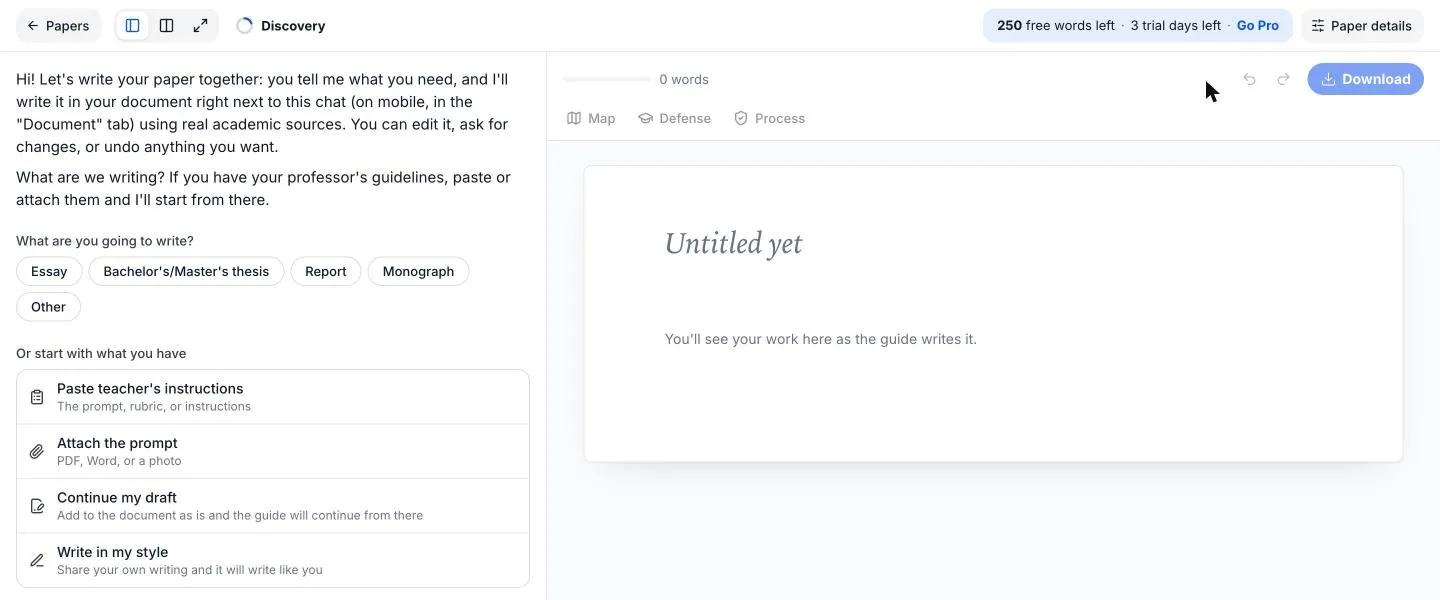
Aithor.io works through your undergraduate or master's dissertation with you: it reads the brief, suggests a title and outline and drafts each section with you using real sources, but it never writes the whole thing in one go or decides what stays. Free: 3-day trial with 40 messages a day and about 250 words written by the guide per paper, no download; anything beyond that is cut off.
AI for dissertationsFrequently asked questions
How long is a dissertation?
There is no standard length. It depends on your university, your subject and your level of study, so the only number that counts is the one in your module handbook. Check whether it includes the reference list, appendices and tables, and how strictly the word limit is enforced.
How long does it take to write a dissertation?
Most undergraduate and master’s dissertations run across a full term or more. An empirical project needs extra time for ethics approval, recruitment and data collection, so start planning as soon as your topic is agreed and work backwards from the deadline.
Can I write a dissertation based only on existing literature?
Many departments accept a literature-based or desk-based dissertation. You still need a clear question, inclusion criteria set before you search and a synthesis organised by theme. If you call it a systematic review, you will also need a protocol and a report that follows a guideline such as PRISMA 2020.
What is the difference between a dissertation and a thesis?
It depends on the country. In the UK and Ireland, a dissertation is usually the research project that closes a bachelor’s or master’s degree, and a thesis is what you write for a PhD. In the US it tends to be the other way round: a master’s thesis and a doctoral dissertation.
Can I use AI to help write my dissertation?
That depends on your university’s policy and sometimes on your supervisor. Where it is allowed, you will usually be asked to say what you used it for. Never submit text you cannot explain in a viva, and never cite a source you have not checked yourself.
What should I do if my research question stops working halfway through?
You rarely need a new topic. Usually it is enough to narrow or reframe the question: change the population, the setting or the method rather than the whole project. Talk to your supervisor before you rewrite anything.
Sources
- The craft of research (4th ed.). University of Chicago Press (2016). doi.org/10.7208/chicago/9780226239873.001.0001
- Independent inquiry and the undergraduate dissertation: perceptions and experiences of final-year social science students. Assessment & Evaluation in Higher Education (2004). doi.org/10.1080/0260293042000188285
- The nature of procrastination: A meta-analytic and theoretical review of quintessential self-regulatory failure. Psychological Bulletin (2007). doi.org/10.1037/0033-2909.133.1.65
- Using thematic analysis in psychology. Qualitative Research in Psychology (2006). doi.org/10.1191/1478088706qp063oa
- The PRISMA 2020 statement: an updated guideline for reporting systematic reviews. BMJ (2021). doi.org/10.1136/bmj.n71
- Guidance for generative AI in education and research. UNESCO (2023). doi.org/10.54675/EWZM9535