Introduction generator for your research paper, move by move
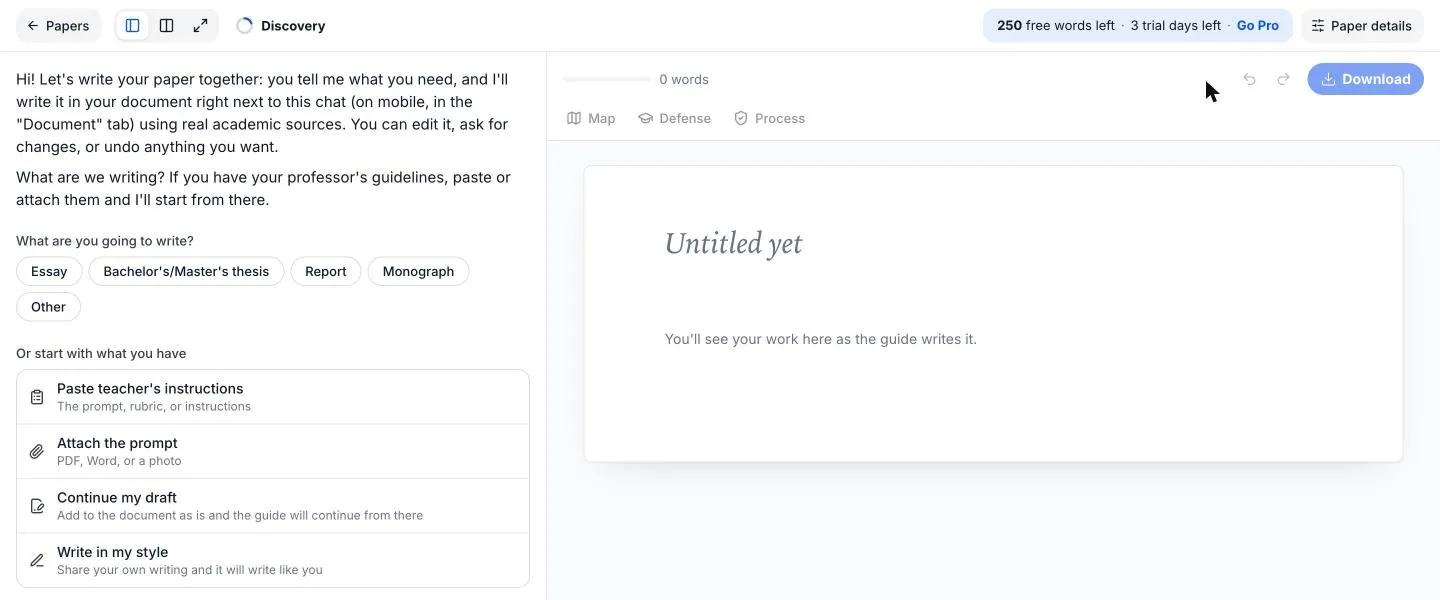
Aithor.io drafts your introduction with you from the assignment brief: context backed by real sources, the gap or problem, your aim or thesis and a roadmap of what follows. You decide what stays and what changes. Free: 3-day trial with 40 messages a day and about 250 words written by the guide per paper, no download; anything beyond that is cut off.
Sign up with Google or your email and start on the free plan, with its limits.
| Cites real academic sources from OpenAlex and Crossref |
| Reads your brief from PDF, Word, PowerPoint, OpenDocument, text or photos (with OCR), up to 20 MB per file and 20 files per paper |
| 300 words per page in 12-point type at 1.5 spacing (225 double-spaced and 450 single-spaced) |
| Imports your draft without rewriting it and carries on from where you left off |
| Free: 3-day trial with 40 messages a day and about 250 words written by the guide per paper, no download; anything beyond that is cut off |
How it works
- Paste or upload your brief; if you've already written part of the paper, import it.
- Pick a title and outline, or tell the guide which sections the paper has.
- Ask for the introduction by name and the guide focuses on that section.
- Check the context, the gap, the aim and the sentence that maps out the paper.
- Adjust the length in words or pages and rewrite anything that doesn't sound like you.
The four moves of an introduction
Researchers who study academic writing describe introductions as a series of “moves”. The details shift from one discipline to another [1], but most introductions do these four things, in this order:
| Move | Question it answers | Common mistake |
|---|---|---|
| Background | What is the topic, and why does it matter now? | Opening too broadly (“Throughout history…”) |
| Gap or problem | What is missing, disputed or not working? | Skipping it, which leaves the paper with no reason to exist |
| Aim or thesis | What does this paper do, or argue? | An aim too big for the word count |
| Roadmap | How is the rest of the paper organised? | Summarising the findings instead of signposting the sections |
An annotated example
Our team wrote this example to show the four moves; it isn’t output from the app. It’s the introduction to an imaginary research paper on lecture recordings. Citations are marked “(citation)”.
Most universities now record their lectures, and students increasingly treat recordings as an alternative to being in the room (citation). Lecturers worry that empty seats mean weaker learning, while students argue that recordings let them work at their own pace (citation).
What remains unclear is who stops attending once recordings are available, and whether those students end up with lower marks or simply study differently.
This paper examines how first-year undergraduates in one department use lecture recordings, combining attendance records with a short survey. Section 2 reviews research on recordings and attendance, Section 3 describes the data, Section 4 presents the results and Section 5 discusses what they mean for teaching.
How it’s built:
- Background. It moves from the general topic (recorded lectures) to the specific tension (attendance), with one or two sources.
- Gap. “What remains unclear” flags what we don’t know yet. This is the sentence that justifies the paper.
- Aim. It says what the paper does, with whom and with which data.
- Roadmap. One sentence that walks through the sections without giving away the results.
How the guide writes it
In Guided writing the introduction has a fixed job: background, gap, thesis and roadmap, with no theory. Because the guide can see your whole outline, it doesn’t drift into the literature review or the results, and the closing sentence maps out the sections your paper actually has.
Background sources come from OpenAlex and Crossref, as everywhere else in the paper, and are cited in your style. If you ask for a particular length in words or pages, it works to it: 300 words per page in 12-point type at 1.5 spacing (225 double-spaced and 450 single-spaced). If the introduction depends on something only you know, such as where you did your placement or what your survey asked, it asks you or leaves a marked gap for you to fill. It won’t make it up.
Once the paper is finished, ask for a coherence review: among other things, it checks that the thesis in your introduction matches what your conclusion says. If you also need an abstract, write it last with the abstract generator.
By type of paper
| Paper | What the introduction can’t leave out |
|---|---|
| Essay | A clear thesis that the rest of the essay defends |
| Research paper | The gap in the literature and a precise research question |
| Dissertation | Aims, objectives and often a short rationale |
| Report | Purpose, scope and intended audience |
If you’re working on a dissertation, the full workflow is in AI for dissertation writing.
Compared with a general AI chat
A general-purpose chatbot can write a decent introduction if you feed it plenty of context. The difference is what it already knows about your paper without being told again.
| Criterion | Aithor.io | A generic AI chat |
|---|---|---|
| Starts from your assignment brief | Yes | Partly |
| Cites real sources in the context | Yes | Partly |
| Works to a length in words or pages | Yes | Partly |
| Knows the rest of your outline so it doesn't jump ahead | Yes | No |
| Checks that your conclusion answers your introduction | Yes | No |
Who it is for
Limits and responsible use
- If the introduction needs details of your own case or experience, the guide asks for them or leaves a marked gap. It won't invent them.
- It doesn't jump ahead to theory or findings; those belong in their own sections.
- An introduction written first needs revisiting last, because it should promise what you actually delivered.
- On the free plan the guide writes only a short amount per paper and you can't download.
Frequently asked questions
Can AI write just my introduction?
Yes. In Guided writing you simply ask for the introduction. It works best once the guide has your brief and outline, because an introduction promises what comes next.
What should a research paper introduction include?
Background on the topic, the gap or problem that justifies the study, your aim, research question or thesis, and a short roadmap of the paper. Some disciplines also expect a brief note on your approach.
How long should an introduction be?
There's no single rule. Check your brief or ask your tutor; a short essay usually needs one or two paragraphs, a dissertation a few pages.
Should the introduction include citations?
Yes, in the background and when you set out the gap, so the reader can see the problem is real. The detailed discussion of theory belongs in your literature review.
What's the difference between an introduction and an abstract?
The abstract summarises the whole paper, findings included, in one paragraph. The introduction sets up the problem and what you'll do, without giving away what you found.
Is it free?
You can try it for free, with a set number of messages and words written by the guide; the trial doesn't renew and doesn't include downloads. The alternative is Write in one go, which drafts the whole paper at once. On the free plan you get one paper, with only its introduction visible and no download.
Which language does it write in?
The language of your brief, or whichever one you ask for, even if you chat with the guide in another.
Will Turnitin flag it?
No tool knows in advance what a detector will flag, and Aithor.io isn't a way to hide AI use. Treat the introduction as a draft, put it into your own words and, if your university requires it, say that you used AI.
Related
Sources
- Introductions in research articles: variations across disciplines. English for Specific Purposes (2002). doi.org/10.1016/S0889-4906(00)00023-5
- Introductions. The Writing Center, University of North Carolina at Chapel Hill. writingcenter.unc.edu/tips-and-tools/introductions/
- Organizing Your Social Sciences Research Paper: The Introduction. University of Southern California Libraries. libguides.usc.edu/writingguide/introduction
Try it with your own paper
Try it on Aithor.io with the free plan, within its limits.
Start for free